

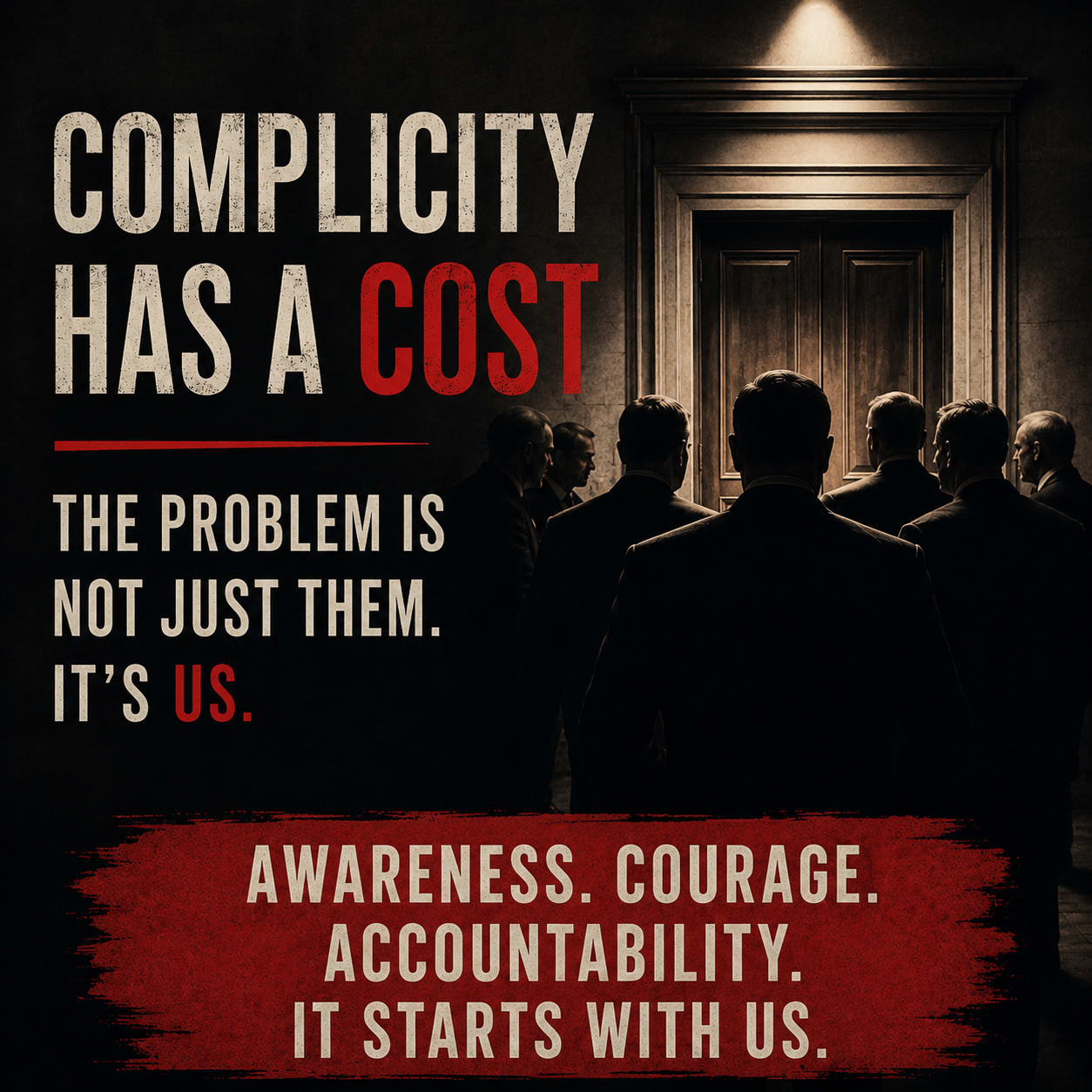
Complicity Has a Cost
The Problem Is Not Just Them. It’s Us.

We wonder how people like Jeffrey Epstein and Ghislaine Maxwell were able to operate in plain sight for decades. We ask how all these victims could be exploited while powerful people looked the other way. We ask why justice came so late for some, and why for many others, it has not come at all.
We want to believe these stories are rare. We want to believe monsters are easy to spot and that systems designed to protect people will eventually do the right thing.
But history keeps telling us a different story.
This pattern is not confined to billionaires, celebrities, or political elites. We see it in churches. We see it in businesses. We see it in our political parties. We see it anywhere institutions become more concerned with protecting their reputation than protecting people.
Just look at how the Southern Baptist Convention handled allegations surrounding Paul Pressler.
It’s a different setting. But it’s the same problem.
Power protected. Institutions closed ranks. Victims paid the price.
When organizations prioritize influence, image, and self-preservation over truth and accountability, the vulnerable are the ones left carrying the cost. The names change. The institutions change. The excuses change. But the pattern remains.
Both the SBC and Epstein expose a sickness in our culture.
We consistently allow people with wealth, influence, status, political power, or spiritual authority to avoid accountability. We excuse behavior we would condemn in others because the person involved is on our side. They vote like us. Worship like us. Build our institutions. Support our causes. Protect our worldview.
Or maybe some of us don’t speak up because of people we are afraid to challenge, disappoint, or make waves with.
And so we rationalize and minimize. We stay quiet.
We tell ourselves someone else will say something.
Tyranny does not only grow because powerful people abuse their positions.
Tyranny also grows because ordinary people learn to look away. It grows when loyalty becomes more important than integrity. It grows when protecting institutions matters more than protecting human beings.
The hard truth is this:
The problem is not just them.
It’s us.
It’s our silence. Silence when speaking up might cost us relationships.
It’s our fear. Fear of confronting leaders we admire.
And sometimes it’s our tribal instinct to defend “our people.”
Complicity always has a cost.
And the people paying that cost are often the most vulnerable among us.
If we want a healthier culture, we have to stop excusing abuse when it comes from people we benefit from, vote for, follow, or admire. And we need to stop excusing the behavior of people that we fear.
It’s time to pay attention.
It’s time to ask harder questions.
It’s time to stand with victims, even when it makes us uncomfortable.
And it’s time to stop being complicit.
Recommended Reading
If you want to better understand both the human cost of abuse and the systems that too often protect the powerful, I recommend Nobody's Girl by Virginia Giuffre and Jesus and John Wayne by Kristin Kobes Du Mez. One gives voice to the survivor. The other helps explain the culture that too often enabled the abuse in the first place.